Call me back |
 My basket |
Checkout |
Add to email list My basket |
Checkout |
Add to email list
|

You are here: Website » Knowledge base
|
DL1 / SpecificationOn this page... (hide) 1. DL1 Introduction and Specification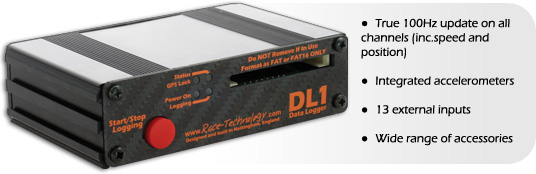 1.1 What is the DL1?The DL1 is a state of the art, highly robust, compact "black box" data logging system. Put in the simplest terms, it stores a wide range of vehicle data for later analysis on a computer - the system does not include an in-vehicle display, although there are products from Race Technology which provide this function. 1.2 Who is the DL1 designed for?The DL1 was initially designed for autosport applications including drag racers, single seater racing cars, rally cars or road cars - however it is also ideal for use on power boats, go karts and motorbikes. It is also an ideal platform for use in the auto industry for car testing of all types, from long term monitoring to competitor benchmarking. 1.3 What does the DL1 do?The DL1 can store data from a number of sources including its built in high accuracy GPS and accelerometers, wheel speeds, shaft speeds, engine speeds, temperatures, pressures, lap times, sector times etc. The DL1 comes packaged with the excellent Race Technology data analysis package for Windows. The software allows super accurate track mapping, user defined channels, powerful graphing and allows direct comparison of up to 10 data sets (races) simultaneously with almost unlimited laps. 1.4 Why use GPS?One of the key features of the DL1 is its built in high accuracy GPS system - this gives the DL1 advantages over other data loggers in 2 key areas - greatly improved track maps and far more accurate speed data. Track MappingConventional data loggers require a "closed circuit" to enable them to calculate the track map; the shape of the track is estimated from a combination of the lateral acceleration and speed. This works adequately in some situations but it becomes increasingly inaccurate for long tracks and impossible for open circuits, motorbikes or boats. In contrast, the GPS will produce high accuracy track maps in almost any situation. Speed MeasurementWhile speed is probably the most important parameter that anyone wants to measure using the data logging system, it is also the most inaccurate in a "conventional" system. The normal way to measure speed is to simply attach a pickup to a wheel to detect how fast it is rotating - but the rolling circumference of a tyre changes by 4% just with wear and temperature. Even worse, the error increases significantly under race conditions where the tyre is under load - typically the tyre slips by up to 20% under hard braking going into a corner. Measuring speed using GPS is now common practice in high-end systems - under typical conditions speed error is well under 1%! 1.5 Introduction to the DL1 data loggerThe DL1 is an all-new, 2nd generation, data logger system from Race Technology. Whilst the DL1 builds on the strengths of our highly successful DL90 system, it is a brand new design in almost every respect. Some of the most noteworthy features include:
1.6 Frequently Asked QuestionsWhat is the maximum g-force/speed that can be measured?The standard DL1 is configured for a maximum of 2g acceleration, 10g is a factory option. The maximum measurable speed is about 1000mph. How often do you get GPS speed updates?The GPS system calculates speed every 200ms (5 Hz), however this data is combined with the data from the accelerometers to calculate speed 100 times every second with very high accuracy. How often do you get GPS position updates?The GPS system calculates position every 200ms (5 Hz), however this data is combined with the data from the accelerometers to calculate position 100 times every second with very high accuracy. How accurately is speed measured?With average GPS reception, speed accuracy is about 0.1mph (or 0.1% if greater) when you are just driving along at fairly constant speed, and about 0.2mph (or 0.1% if greater) during fast accelerations or braking. The only exception is at very low speeds (under 10mph) where the error increases to about 1mph. Do not be fooled by exaggerated claims from other manufacturers… this is as good as it gets! In contrast, a standard wheel speed pickup is only accurate to about 4% at constant speeds, and under high accelerations or braking, the error increases up to about 20%. How accurately is position measured?With good GPS reception, positional accuracy is about 3m (CEP). What happens to the data if you drive under a bridge/tunnel/trees etc?Because speed and position are calculated from both the GPS data and accelerometers, even if the GPS data "disappears" for a number of seconds, you won't be able to tell from the data in the software. Only if GPS data disappears for an extended time (20+ seconds) will the data start to degrade noticeably. Where can I buy it?Check for an up-to-date list of stockists Is it upgradeable?The DL1 is upgradeable in a number of ways; please check www.race-technology.com for an up-to-date list of options. Software and firmware updates, including new features, are freely available as we introduce them. How much data can you log to a Compact flash card?The DL1 logs about 18MB of data per hour, so for a 64MB card you could get up to about 3.5 hours of data, for a 2GB card you could get about 5 days! Will it work with any Compact Flash card?Whilst we cannot guarantee that the DL1 works with all compact flash cards, we have successfully tested many makes and sizes of compact flash card, we haven't yet found one it won't work with. A list of flash cards that have been tested is available on the website. Is it easy to use?The DL1 has one button to start and stop logging, how much simpler could we have made it? We have kept the software as simple as possible whilst making it as flexible as we can to ensure that you can do what you need to with it. As with all computer programs, the first time you use it there is a lot to take in - after you've become familiar with it, you will be able to analyse data quickly and efficiently. What specification of computer is required?As with most programs, the analysis software will run on just about any PC with windows 95 or later - however, the faster the PC, the faster the program will run. The main restriction is the memory required for long runs; typically we recommend that your PC has an absolute minimum of about 30MB of memory installed for each hour of data loaded. The PC also requires some means of downloading the data from the compact flash cards, there are many options available - normally a USB reader is most convenient. Is the DL1 reliable and well made?The DL1 is absolutely class leading in terms or component quality, build quality and reliability - this is a very high quality professional instrument, entirely designed in-house and manufactured in England. The unit carries the normal 12 month guarantee against manufacturing defects and lifetime email support. 1.7 Technical Specification
"WARNING": To avoid any possible damage to the car paintwork, please take care when mounting magnetic GPS antennas. In particular make sure that there are no dust or grit under the antenna. In some cases it maybe required to add additional protection to the paintwork prior to mounting the antenna to avoid damage. |



 Edit
Edit History
 Print
Print Download (.HTML)
 PDF
PDF