Introduction
What are the DL1 FD?
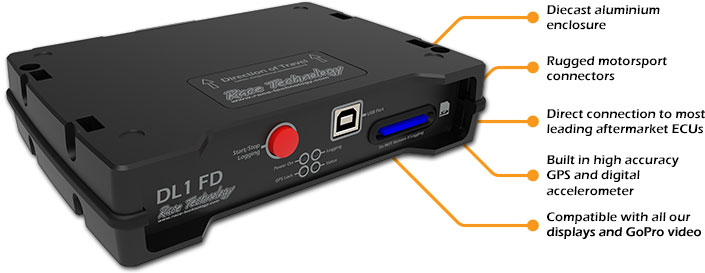
The DL1 FD is a versatile data logger designed for motorsport applications with a diecast aluminium case and easy to use connectors for quick and easy installation.
Who is the DL1 FD?
The DL1 FD is designed for autosport applications including drag racers, single seater racing cars, rally cars or road cars - however they also ideal for use on power boats, go karts and motorbikes. They are also an ideal platform for use in the auto industry for car testing of all types, from long term monitoring to competitor benchmarking.
What does the DL1 FD do?
The DL1 FD can store data from a number of sources including its built in high accuracy GPS and accelerometers, wheel speeds, shaft speeds, engine speeds, CAN data, including CAN FD, temperatures, pressures, lap times, sector times etc. The DL1 FD comes packaged with the excellent Race Technology data analysis package for Windows. The software allows super accurate track mapping, user defined channels, powerful graphing and allows direct comparison of up to 10 data sets (races) simultaneously with almost unlimited laps. The DL1 FD can also be used to supply data to dashboard displays and to drive auxiliary outputs to control fans, pumps, or lights.
Why use GPS?
One of the key features of the DL1 FD is its built in high accuracy GPS system - this gives the DL1 FD advantages over other data loggers in 2 key areas - greatly improved track maps and far more accurate speed data.
Track Mapping
Conventional data loggers require a "closed circuit" to enable them to calculate the track map; the shape of the track is estimated from a combination of the lateral acceleration and speed. This works adequately in some situations but it becomes increasingly inaccurate for long tracks and impossible for open circuits, motorbikes or boats. In contrast, the GPS will produce high accuracy track maps in almost any situation.
Speed Measurement
While speed is probably the most important parameter that anyone wants to measure using the data logging system, it is also the most inaccurate in a "conventional" system. The normal way to measure speed is to simply attach a pickup to a wheel to detect how fast it is rotating - but the rolling circumference of a tyre changes by 4% just with wear and temperature. Even worse, the error increases significantly under race conditions where the tyre is under load - typically the tyre slips by up to 20% under hard braking going into a corner. Measuring speed using GPS is now common practice in high-end systems - under typical conditions speed error is well under 1%!
DL1 FD Features
The DL1 FD builds on the previous DL1 PRO with updated features. Retaining many of the existing features of the DL1 PRO. Some of the most noteworthy features include:
The DL1 FD is housed in a strong diecast aluminium enclosure, with connections on the rear through a pair of high quality 12 way connectors which enable quick and easy installation and removal from the vehicle
The updated GPS receiver in the DL1 FD gives improvements over the previous version, particularly in conditions of poor GPS coverage. As previously, the measurements from the GPS and accelerometers are combined to calculate very high accuracy positions and speeds at 100 times a second.
Built in 3-axis accelerometer with 2g full scale (optional 6g full scale).
Works with SD and SDHC, for up to 32GB storage and internal non-removable 8GB on the DL1 FD
The DL1 FD has 12 very high accuracy analogue inputs (8 as standard, extra 4 optional). All inputs have a maximum of 25V input. Optional logging at up to 1kHz.
Low side driver outputs are available for controlling pumps, fans, lights.
The DL1 FD has 2 RPM inputs, only one of which can be used at any one time. One input is designed to be connected to "high level" sources, such as the ignition coil. The other input is designed for low level signals such as a feed from the ECU.
- 4 wheel/shaft speed inputs
The DL1 features 4 totally independent wheel/shaft speed inputs. These can be used to measure the speed of all four wheels, or slip ratios across a torque converter for example.
Either port can be used to receive data for logging, or to output data for storage to a laptop or to a DASH display.
Both on the rear panel, one on a d-type connector and one on a DTF connector, the dual CAN FD ports enable receiving and transmitting of messages. Also compatible with CAN FD at data rates up to 5Mbit/s
- Remote start/stop and add marker inputs
- Dual 5v reference outputs
Two independent 5v outputs can be used to drive up to 500mA each for sensor outputs.
Install a manual start/stop button to start and stop logging from the drivers seat, or use the fully automatic start/stop functions so you can concentrate on driving and let the data logger take care of the logging; it's as simple as that!
- Power supply requirements
The power supply to the DL1 FD data logger can be taken directly from the vehicles 12v supply, or it can be powered from its own battery if required. The power supply is smoothed and regulated within the DL1 FD ensuring its performance is highly robust and stable.
USB connection for direct connection to a PC for configuration or for monitoring live data.
Very high reliability is ensured by calibrating, temperature testing and vibration testing each unit on an individual basis. Autosport applications make tremendous demands on electronic systems and we take great care to make sure our products are up to the task. All the connections to the units are vibration proof, high strength to ensure that connections do not fail at the critical time.
 My basket |
Checkout |
Add to email list
My basket |
Checkout |
Add to email list




 Edit
Edit History
 Print
Print Download (.HTML)
 PDF
PDF